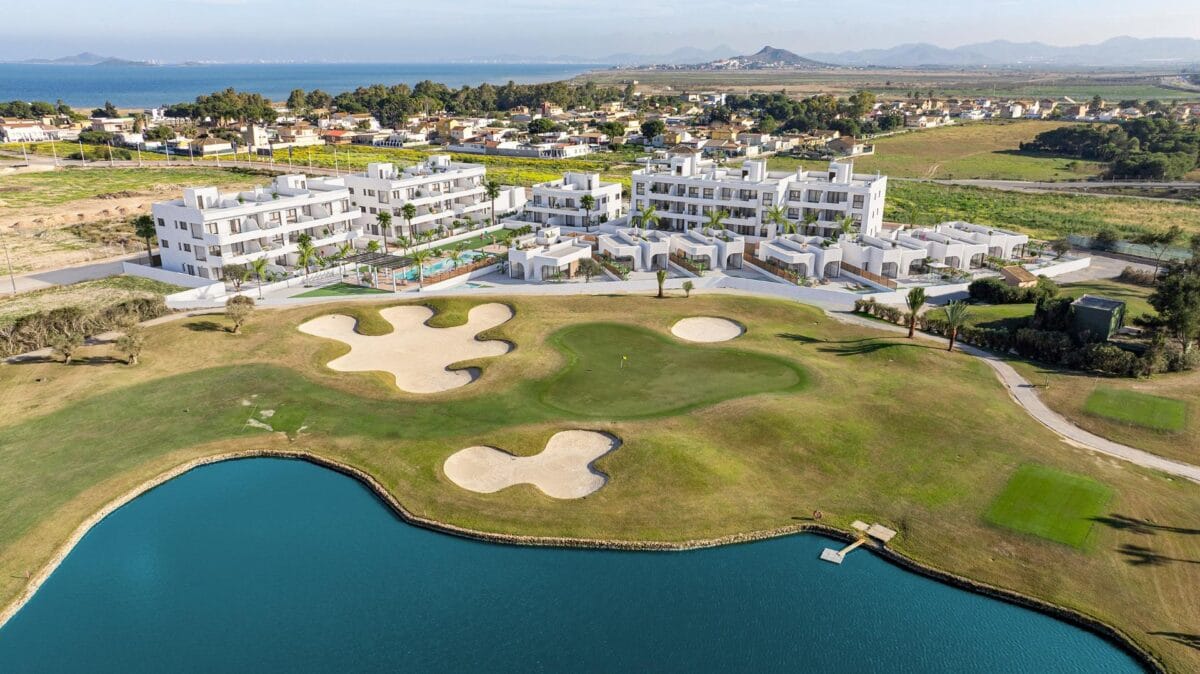
Murcia Property - Find Your Place on the Costa Cálida

Find Your Place on the Costa Cálida

The Murcia property market is one of Spain’s most exciting, 35% more affordable than the national average, with 320 days of sunshine, two coastlines, and some of Europe’s best golf resorts. Whether you’re buying a holiday home, relocating permanently, or investing in Murcia real estate, start your search here.
MARKET OVERVIEW

Murcia recorded Spain’s fastest annual price growth in 2025 at 25.8%, yet it remains one of the Mediterranean’s most affordable markets. Here’s what the data shows.

€1,281/m²

Average House Price 35% below Spain's national average

+25.8%

Annual Price Growth (2025) Fastest in Spain forecast 3–7% in 2026

25%

Foreign Buyer Share ~3,840 international sales in 2024

320+

Sunshine Days Per Year 2M+ annual tourists on the Costa Cálida

Murcia Property FAQs

Everything buyers need to know before purchasing property in the Murcia region is answered by local experts.

Can foreigners buy property in Murcia, Spain?

Yes – there are no restrictions on foreign nationals buying property in Spain, whether you are an EU citizen or from outside the EU (including post-Brexit UK nationals). You will need an NIE number (Número de Identidad de Extranjero, Spain’s foreigner tax ID), a Spanish bank account, and an independent conveyancing lawyer. Most buyers work with a local lawyer from the start to handle the NIE application, property searches, and the purchase contract. Allow 2–8 weeks to obtain an NIE.

What taxes do I pay when buying property in Murcia?

For resale properties, you pay Property Transfer Tax (ITP) at 8% of the purchase price, lower than Alicante (10%) or Catalonia (10%). For new build properties, you pay VAT (IVA) at 10% plus Stamp Duty (AJD) at 2%. On top of that, budget for notary fees (€800–€2,000), Land Registry fees (€400–€1,200), and legal fees (typically 1% of purchase price). In total, add 10–13% on top of the purchase price to cover all costs.

What are the best areas to buy property in Murcia in 2026?

It depends on your priorities:

La Manga Club — Best for year-round rental income and golf lifestyle. Highest prices (€280k–€650k+), but strongest occupancy rates.
Los Alcázares — Best for expat community and Mar Menor beach access. Affordable (€90k–€280k) and well-served by healthcare, restaurants, and international schools.
Condado de Alhama / Torre Pacheco — Best for new build investment. Modern golf resort villas from €180k with private pools.
Cartagena — Best for city living, Roman heritage, and urban investment.
Mazarrón — Best value coastal property. Prices 30–40% lower than La Manga for equivalent spec, with growing international demand.

Is Murcia a good place to buy property as an investment?

Murcia has strong fundamentals for property investment in 2026: it recorded Spain’s fastest price growth in 2025 (+25.8%) while remaining 35% more affordable than the national average. The region attracts 2 million tourists annually, and foreign buyers predominantly from the UK, Belgium, and Scandinavia, accounted for 25% of all sales in 2024. Coastal properties, particularly those on golf resorts with holiday rental licences, offer both rental yield (€800–€2,500 per week in peak season for a 3-bed villa) and capital appreciation potential. As with any property investment, local legal and financial advice is essential before committing.

How do I get an NIE number in Murcia?

An NIE (Número de Identidad de Extranjero) is Spain’s foreigner tax identification number, essential for any property transaction. You can apply in person at a Spanish Police Station or Immigration Office (Oficina de Extranjería) in Murcia or Cartagena, or appoint a registered lawyer to obtain it on your behalf using a Power of Attorney. The application fee is typically €10–€20, though using a lawyer or gestor may cost €50–€200 for the service. Allow 2–8 weeks, depending on appointment availability. Your NIE must be in place before you sign any purchase contract or pay more than a reservation deposit.

What is the difference between the Costa Cálida and the Costa Blanca?

The Costa Cálida (Murcia’s coastline) runs from Águilas in the south to Lo Pagán in the north. The name means “warm coast,” a reference to the uniquely warm waters of the Mar Menor lagoon, which rarely dip below 14°C even in winter. The Costa Blanca is the coastline of the Alicante province to the north (Torrevieja, Dénia, Benidorm). Both offer similar Mediterranean climates, but the Costa Cálida is generally less densely built-up, more affordable, and growing faster in terms of international interest. Many buyers who initially research the Costa Blanca find better value on the Costa Cálida once they compare the two.

© 2025 ListMyBizMurcia. All rights reserved.